East Coast West Coast 1920s Photos

My collecting focuses on photographs taken after 1930 in the United States. Earlier photographs taken on the east and west coasts have a special quality in that many were taken outdoors. Many of these photographs of female models follow tropes found in art. These photographs were not reproduced in vast quantities like the female nude photographs taken in the 1950s.

Outdoor nude postcards, New York, circa 1920. I wish I knew more about AAB Company and the creators of their postcards. Similar style photographs were produced in California by Alta Studios.

Arts Beautiful magazine, 1920s. This is packed away and all I have readily available is the scan of the cover and one interior page. The cover is possibly an Alta Studios photograph. The interior photograph is Alta Studios of California.

Mack Sennett postcards, Los Angeles, circa 1917. Sennett is an important early film maker. I am not sure if she is one of his bathing beauties from his popular film shorts or if this scene and actress is associated with one of his feature films.


Named Guyette Models

Along with being the best introduction to the subject, Charles Guyette: Godfather of American Fetish Art by Richard Pérez Seves provides identification of several Guyette models. I’m going to amplify that identification a little here.

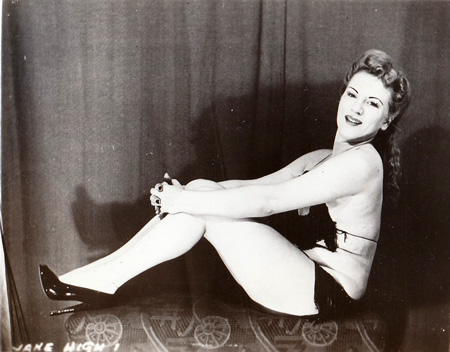
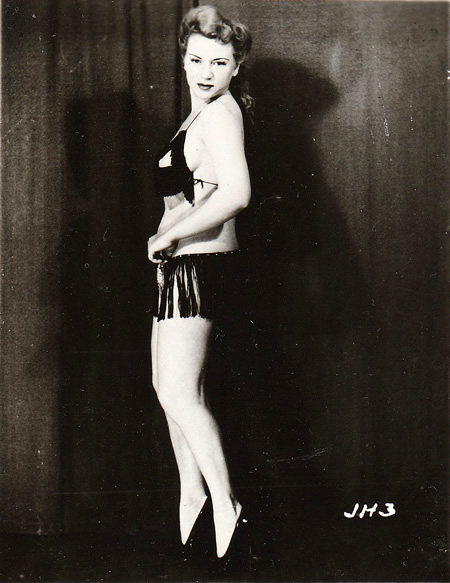
Jane High was a Guyette model who had a small number of her Guyette photos reprinted by Irving Klaw with her name. From the costuming it appears that she was a burlesque artist.

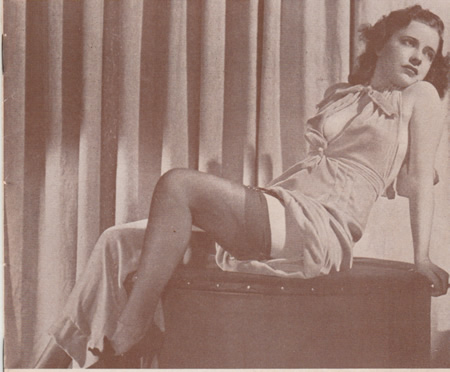
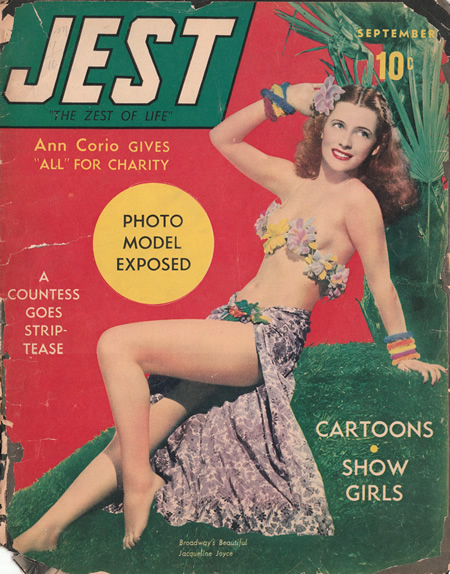
More is known about another model, Jacqueline Joyce, also a burlesque performer. She was born in Toronto and moved to New York City to advance her career. According the 1937 Picture Review which featured her on its cover, she was performing at that time at Mario’s Club Mirador on 52nd Street. She was five foot three inches and weighed 108 pounds according to Picture Review. Her career as a performer extended at least until the early 1950s. The first illustration below is from the cover of Picture Review. The second illustration is her appearance on the 1941 cover of Jest magazine.


Around 1930

Around 1930 in Europe postcards where being created in huge quantities. Biederer Studio was one creator producing postcards and other sized photographs in a wide range from purely pornographic to purely cheesecake. This is an upskirt photo that is postcard size but without the postcard back.

Around 1930 in America women inspired by Amelia Earhart were wearing leather jackets styled after flying jackets. This is a photograph of a young woman wearing an aviatrix costume. The cap makes her look like an actual pilot but this may have more a costume for her.


Burlesque Style Photographs

I tend to think of vintage photographs of women as falling in one of several genres. There’s the pinup. There’s the nude. And somewhere in between is the burlesque style photograph which can have a little of both genres. There is usually a performative aspect to these three genres. What keeps a burlesque style photograph from being a plain nude photograph is the element of costuming. An element of nudity keeps the photograph from being purely a pinup. Here are three examples of burlesque styling.

The first photograph is a 4×5 inch print and is pure burlesque styling. The second photograph, also a 4×5 inch print, is a pinup with burlesque styling. The first two photographs where probably shot around 1950. The third photograph is earlier, 1940s, and is a 3.5×5.5 inch print. The setting of this photograph is similar to some Guyette photographs, bare wall background, a piece of cloth covering the floor. This isn’t a Guyette photograph but shows that at least some of his photographs fall within an existing sensibility.


Time collides

Time collides when someone dies | The past overwhelms the present

That popped into my head when I was starting to mop the floor so I had to find a pen and scratch pad and write it down before I got too caught up in what I was doing and forgot. Both ideas popping and forgetting are sort of how my mind works.

Last night my partner and I were talking about a funeral the daughter attended recently for a high school classmate. The daughter is in her fifties and is herself starting to feel the tail of time dragging behind her. After the funeral the classmate’s father went up to the daughter and in his profound grief told her, “You know, your mother was really hot when she was a teenager.” To which the daughter said, “I’ve been told that.”

My memories of the classmate are tied to those of my partner, too. He was a person who always smiled, seemed at that time of his life after graduation to have found profound happiness. We were in our thirties then and the tail of time wasn’t quite so long.

My adventures in grief didn’t start until I was in my early forties when my brother died. I was thinking of him this weekend; when he was in the hospital and I was describing a near misadventure with the chainsaw and a tree and I was laughing about it. The look on his face.

It wasn’t until my fifties that close friends died. My college roommate and best friend and what I did to that relationship. A woman who I never took seriously enough. There’s a post of mine which I won’t link to because it is inadequate. I think of her almost daily still. The beautiful woman, another post I won’t link to. She was foundational for me and I don’t think I would be in this relationship with my partner without that time with her.

I have things I use almost daily from those who have died, beyond the thoughts that cluster like stars in my head. After my brother died I wore his clothes until they fell apart. I have a friend’s jacket and leather gloves. A bin of clothes from another friend that I can’t wear because they smell like him and that smell now is of loss.

I’ve thought of posting a photo of my razor but I haven’t. It was my grandfather’s and it’s the best razor I’ve used for shaving. The nickel plating has worn off showing the brass and the brass is not shiny but has a deep patina of its own. I think the patent dates back to the early years of the twentieth century. Perhaps he had it in France when he fought there in World War I, but probably not. Maybe when he worked in the steel mills before the Depression hit hard. Surely he had it when he was a prison guard in the federal system before the next world war.

The objects are just tokens. All I really have of these people who are gone and the people I know who are still here is memories and the things we share. For some the present implies a future, for others all that remains is the past.