The Price of Salt

Just a quick post. The movie Carol is based on Patricia Highsmith’s (writing as Claire Morgan) 1952 book The Price of Salt.

Most 1950s (and later) readers were/are familiar with the book in its various paperback editions. Here’s the front and back covers of the first printing of the first paperback edition, September 1953).

Our copy is inscribed September 1953.


Contest

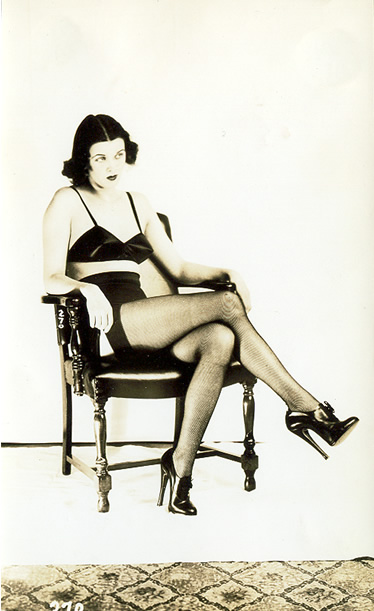
This American photographer’s work often shows features commonly seen in modern fashion photography. The contest is to properly tell in which decade this photo was made and who the photographer/distributor was. Good luck!


John Willie’s Bizarre

John Willie moved to North America the end of 1945 intending to publish a fetish magazine. He settled first in Montreal and then moved to New York City. He brought from Australia photographic negatives and ideas for artwork and the type of magazine he wanted to produce.

Bizarre was published by Willie from 1946 until 1956 when he sold the magazine to a friend who published a few more issues before the publication folded. The magazine was filled with original artwork by Willie, photographs by Willie and others, stories, and letters to the editor. Most issues before 1956 had cover illustrations by Willie and some have his comics. Willie’s interests were bondage and fetish apparel (especially high heel shoes) but the magazines depended on material furnished by readers so the range of activities and dress was wide.

All the issues of Bizarre were reprinted by Taschen in the 1990s in two volumes and copies can still be found online. Original copies sometimes appear on eBay. I’m reproducing the front cover and a few pages from number 11 published in 1952.

The cover artwork by Willie shows some of the activities and dress found in Bizarre. This artwork carries forward an idea he presented in his only published artwork in London Life magazine (1935), the magazine that was the inspiration for Bizarre.

This photograph for an article about high heel shoes appears on page 7. I’m not sure, but I suspect the photo was taken by Willie in Australia in the 1930s with his second wife Holly as model.

This is the beginning of NYC’s story “From Girl to Pony” (on page 24) which is completed in issue 12. The artwork is by Willie.

This is a photograph on page 32 by Willie taken in Australia of Holly. In the late 1940s Willie sold a number of his bondage and high heel photos of Holly and others taken in Australia in the 1930s (and possibly early 1940s) to Irving Klaw. Klaw carried these photos in his catalogs until about the mid-1950s.

The reader’s photograph appearing on page 63, above part of another reader’s letter, shows the properly attired 1950s Domme. A copy of a 1946 issue of Bizarre is lying on the floor by her right shoulder. This same issue appears in September 2012 InStyle magazine (on page 488). The vintage copy was purchased by an editor who liked “the gorgeous images of shoes.”


Pulps

Pulps took two forms, as magazines in the 1930s to the present and paperbacks after 1939 (though pulp paperbacks existed long before). Paperbacks ranged from classic novel reprints to hardboiled sleeze with a sexual edge. I’ll do another post or two about magazines. Here are three pulp novels published by Beacon Books (Universal Publishing and Distributing Corporation of New York City).

Orrie Hitt. Girls’ Dormitory.

From the back cover: Girls will be girls.

Orrie Hitt was the pen name of the male author who wrote a variety of sleeze titles, including lesbian fiction as Kay Addams.

Cal Anton. Strip-Tease Girl. Published in 1959.

From the back cover: She couldn’t say no.

L. T. Woodward, M.D. The Deceivers. Published in 1962.

From the back cover: Complete in every intimate detail!

Do suburban housewives often leap from premarital virginity to licentious sexual promiscuity? See the case history of Ruth F.

A few pulps from the 1950s have been recently reprinted: Ann Bannon’s Beebo Beeker novels, Valerie Thomas’ Girls of 3-B and Tereska Torres’ Women’s Barracks (all are lesbian pulps).

Susan Stryker’s Queer Pulp: Perverted Passions from the Golden Age of the Paperback (San Francisco: Chronicle Books, LLC, 2001) is a fascinating introduction.


Out of Context, 2

1. Mary McCarthy, The Company She Keeps (New York: Dell Publishing Co., 1942) — I really liked this book by the way:

“After that the man had come around to her side of the table and kissed her rather greedily. She had fought him off for a long time, but at length her will had softened. She had felt tired and kind, and thought, Why not? Then there had been something peculiar about the love-making itself — but she could not recall what it was. She had tried to keep aloof from it, to be present in body but not in spirit. Somehow that had not worked out and she had been dragged in and humiliated. There was some comfort in this vagueness, but recollection quickly stabbed her again. There were (oh, holy Virgin!) four-letter words that she had been forced to repeat, and at the climax, a rain of blows on her buttocks that must surely (dear God!) have left bruises. She must be careful not to let her aunt see her without any clothes on, she told herself, and remembered how once she had visualised sins as black marks on the white soul. This sin, at least, no one would see.”

2. John Fowles, The French Lieutenant’s Woman (Boston: Little, Brown and Co., 1969):

” ‘What has kept me alive is my shame, my knowing that I am truly not like other women. I shall never have children, a husband, and those innocent happinesses they have. And they will never understand the reason for my crime.’ She paused, as if she was seeing what she said clearly herself for the first time. ‘Sometimes I almost pity them. I think I have a freedom they cannot understand. No insult, no blame, can touch me. Because I have set myself beyond the pale. I am nothing, I am hardly human any more.’ “

3. Courtney Ryley Cooper, Designs in Scarlet (Boston: Little, Brown and Co., 1939) — On spanking clubs and other nefarious activities with a dash of Lautremont tossed in:

“Remember always that it is the sado-masochist who attacks little girls, or who slashes out their bowels, or who beats women to death and rapes them after life has left their bodies.”

Cooper wrote screenplays for movies and true crime for pulps.

4. I’ve been extraordinarily busy recently finishing a project started two years ago.

5. The leaves are starting to fall off the trees:

“At my poore house you shall behold this night,
Earth treading stars, that make darke heaven light.”
William Shakespeare, Romeo and Juliet, first (or bad quarto), I,ii.